
Buttoning a shirt.
Holding a spoon.
Opening a jar.
Typing a message.
Picking up a coin.
Turning a key.
Many everyday activities depend on hand and finger dexterity.
As people grow older, changes in strength, joint movement, sensation or coordination may make some of these tasks more difficult.
Simple hand activities may help older adults keep their hands active, but exercises should always be adapted to the person’s ability — especially when there is pain, arthritis, numbness, weakness or a neurological condition.
Quick Answer: What Are Finger Dexterity Exercises for Seniors?
Finger dexterity exercises are simple hand movements that encourage coordination, flexibility and controlled use of the fingers.
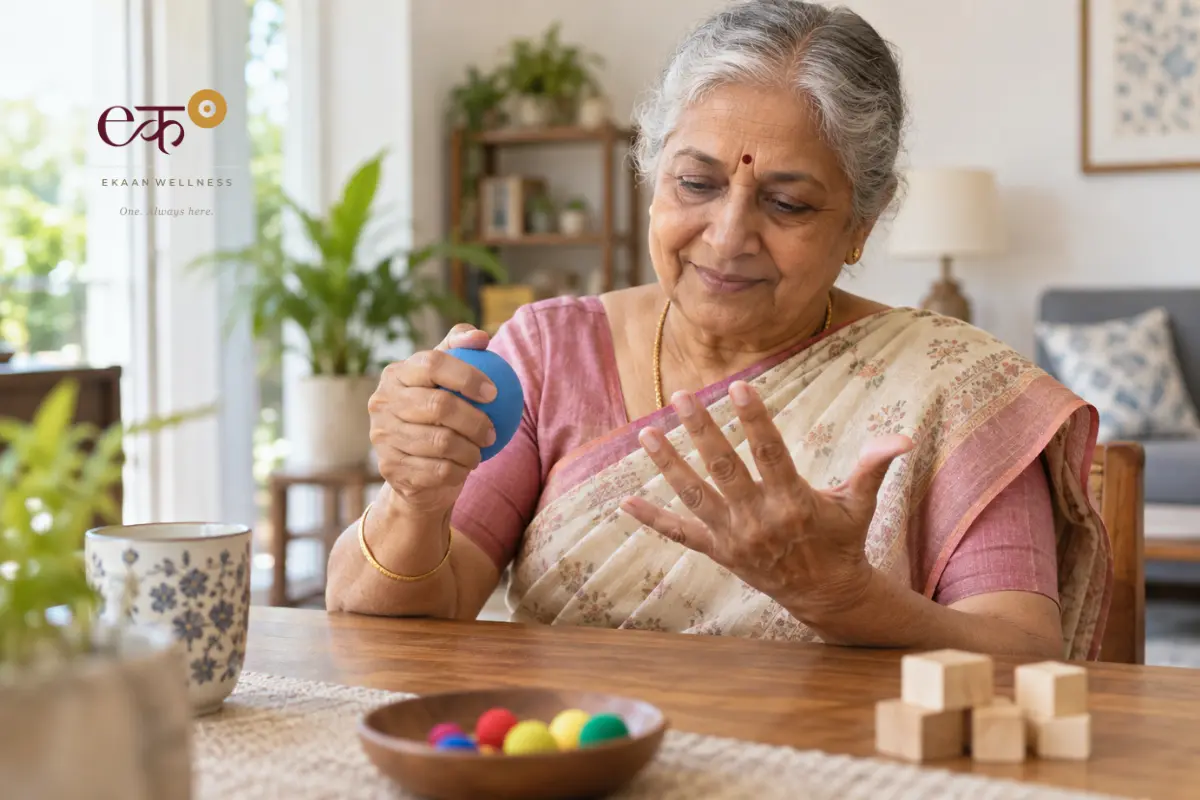
Examples can include finger taps, thumb-to-finger touches, gentle fist opening, picking up small safe objects and squeezing a soft ball.
These activities are intended to support everyday hand use. Persistent pain, numbness, sudden weakness or major loss of function should be professionally assessed.
Why Is Hand Dexterity Important for Older Adults?
Dexterity refers to the ability to make controlled and coordinated movements, particularly with the hands and fingers.
Good hand function supports many activities of daily living, including:
- dressing
- eating
- writing
- using a phone
- handling money
- preparing food
- opening containers
- using keys
- taking part in hobbies
A small change in finger movement can therefore affect independence more than families initially realise.
Our broader guide on mobility in older adults explains how movement, strength and functional independence can change with age.
Why Can Finger Dexterity Decline With Age?
Hand function can change for several reasons.
Possible contributors include:
- joint stiffness
- arthritis
- reduced grip strength
- reduced sensation
- previous injury
- neurological conditions
- reduced use of the hands
- recovery after illness
- pain or swelling
Not every change is caused by ageing alone.
If a parent suddenly loses strength or coordination in one hand, develops significant numbness or has severe pain, professional medical assessment may be needed.
Everyday Signs of Reduced Hand Dexterity
Families may notice that an older parent:
- takes longer to button clothes
- struggles with zips
- frequently drops objects
- has difficulty holding cutlery
- finds handwriting harder
- struggles to open medicine packaging
- avoids using small buttons on a phone
- has difficulty turning a key
- cannot easily pick up coins
- avoids hobbies requiring fine hand movements
These small frustrations can gradually reduce independence.
It is useful to notice them early rather than simply completing every task for the person.
Simple Hand and Finger Exercises for Seniors
These movements should be gentle and comfortable.
They should not cause significant pain.
If the person has an existing hand condition, recent injury, surgery or neurological disorder, ask an appropriate healthcare professional whether the activity is suitable.
1. Open and Close the Hand
Start with the hand relaxed.
Slowly:
- open the fingers comfortably
- spread them slightly apart
- gently close them into a loose fist
- open the hand again
Repeat slowly.
Avoid squeezing the fist forcefully.
What it works on:
Finger movement and general hand mobility.
2. Thumb-to-Finger Touches
Hold one hand comfortably in front of the body.
Touch the thumb to:
- index finger
- middle finger
- ring finger
- little finger
Then move back in the opposite direction.
Try to form a gentle circle between the thumb and each fingertip.
What it works on:
Coordination and precision.
3. Finger Taps on a Table
Place the hand flat on a table.
Lift one finger gently and return it to the surface.
Move through each finger one at a time.
The movement does not need to be high.
What it works on:
Individual finger control.
4. Finger Spreading
Place the hand comfortably on a flat surface.
Slowly spread the fingers apart.
Hold briefly.
Then bring them back together.
What it works on:
Controlled finger movement.
5. Soft Ball Squeeze
Use a soft foam or therapy ball that is easy to compress.
Gently squeeze it without causing pain.
Release slowly.
Do not use a hard resistance tool simply because stronger resistance seems “better.”
What it works on:
Grip activation.
People with painful arthritis or other hand conditions should check whether squeezing exercises are appropriate for them.
6. Pick Up Small Safe Objects
Place a few safe objects on a table, such as:
- large buttons
- coins
- bottle caps
- soft game pieces
Ask the person to pick them up one at a time and place them in a bowl.
What it works on:
Fine motor coordination and precision.
Avoid very small objects where swallowing risk or other safety concerns exist.
7. Coin Transfer
Place several coins on one side of a table.
Move them individually to another area.
The activity can also be done using larger tokens if coins are difficult.
What it works on:
Pinching and controlled finger movements.
8. Paper Crumpling
Take a sheet of lightweight paper.
Use one hand to gently crumple it.
Then attempt to open it again.
This can be turned into a simple activity rather than feeling like formal exercise.
What it works on:
Whole-hand coordination.
Everyday Activities Can Also Support Hand Use
Exercise does not always need to look like therapy.
Depending on ability, ordinary activities can help keep the hands active.
Examples include:
- folding clothes
- arranging cards
- gardening
- simple cooking tasks
- sorting objects
- writing
- painting
- knitting
- using board games
- handling prayer beads
- using a smartphone
The best activity is usually one the person actually enjoys.
Make the Goal Functional, Not Just “Stronger Hands”
For an older adult, the meaningful goal may be:
“I want to button my kurta myself.”
or:
“I want to use my phone without asking someone.”
or:
“I want to continue cooking.”
These goals are much more useful than simply saying:
“You need better hand strength.”
When hand exercises connect to everyday independence, they are easier to understand and more motivating.
What If an Older Adult Has Arthritis?
Hand stiffness and pain are common concerns for people living with arthritis.
Exercise recommendations should depend on:
- which joints are affected
- pain level
- swelling
- range of movement
- medical advice
Gentle movement may be appropriate for some people, but significant pain should not be pushed through.
If exercises repeatedly worsen symptoms, stop and seek professional advice.
When Is Occupational Therapy Useful?
Occupational therapy focuses on helping people perform everyday activities as independently and safely as possible.
An occupational therapist may assess tasks such as:
- dressing
- eating
- bathing
- writing
- food preparation
- using devices
- handling household objects
They may recommend:
- activity modifications
- adaptive equipment
- hand exercises
- environmental changes
- different ways of completing a task
This can be especially useful when hand problems are interfering with daily life.
Ekaan’s higher-support membership structure includes occupational-therapy assessment as part of broader functional and home-safety evaluation. Families can compare Ekaan Wellness memberships to understand the different levels of support available.
Hand Dexterity and Medication Management
Reduced dexterity can affect something families may not immediately connect with hand function: medicines.
An older adult may struggle with:
- opening blister packs
- handling small tablets
- opening bottles
- using inhalers or devices
- reading and handling labels
Families should notice when packaging itself is becoming difficult.
Do not transfer medicines into unlabelled containers or change medication routines without appropriate guidance.
Instead, discuss practical difficulties with the relevant healthcare professional or pharmacist.
Technology Can Reveal Dexterity Changes Too
Phones and tablets require:
- tapping
- swiping
- typing
- pinching
- holding the device securely
If a parent suddenly stops using technology they previously enjoyed, ask why.
The issue may not be lack of interest.
They may be struggling with:
- small buttons
- reduced sensation
- vision
- tremor
- coordination
- hand pain
Simple accessibility adjustments may make devices easier to use.
When Should Hand Weakness or Dexterity Problems Be Assessed?
Seek appropriate medical advice when there is:
- sudden hand weakness
- sudden loss of coordination
- persistent numbness
- severe or increasing pain
- significant swelling
- loss of grip
- difficulty using one side of the body
- symptoms following an injury
- rapid decline in hand function
Sudden weakness, especially when accompanied by facial changes, speech difficulty or weakness elsewhere in the body, can require urgent medical attention.
Hand Function Is One Part of Independence
An older parent’s independence depends on many abilities working together:
- walking
- balance
- hand function
- memory
- vision
- confidence
- home safety
That is why hand dexterity should not be viewed as an isolated problem.
A person who is struggling with hand movements may also be experiencing other changes in mobility or daily function.
Families noticing broader changes can review Ekaan’s elder care guide for a wider view of health, mobility, nutrition, companionship and home support.
Supporting Independence Without Taking Over
It can be tempting to immediately help whenever a parent struggles with a small task.
Sometimes help is needed.
But when the person can safely complete the activity with more time, allowing them to try can help preserve confidence and independence.
Instead of automatically taking over, consider asking:
“Would you like me to help, or would you like a little more time?”
The difference is small.
But it keeps control with the person receiving support.
How Ekaan Wellness Fits Into Functional Support
Hand dexterity is only one example of how everyday function can change with age.
Ekaan Wellness combines managed elder care with therapeutic and wellness support, with Care Manager involvement depending on the membership selected.
For families whose parent’s needs extend beyond one specific exercise or activity, Ekaan Wellness memberships provide different levels of coordinated support.
Where more medically oriented rehabilitation or physiotherapy is required, families can also read Ekaan’s guide to home health care services in Delhi NCR.
Frequently Asked Questions
What are finger dexterity exercises for seniors?
Finger dexterity exercises are gentle movements designed to practise coordinated hand and finger control. Examples include finger tapping, thumb-to-finger touches and picking up small safe objects.
Can hand exercises improve finger movement in elderly people?
Appropriate activity may help maintain or practise hand movement, coordination and strength. Results depend on the cause of the difficulty, so persistent or significant problems should be professionally assessed.
How often should seniors do hand exercises?
There is no single frequency suitable for everyone. Gentle activities can often be incorporated into daily routines, while people with pain, arthritis, injury or neurological conditions may need individual guidance.
What activities improve fine motor skills in seniors?
Activities such as sorting coins, handling cards, writing, gardening, cooking, crafts and using everyday objects can practise fine motor control when they are safe and appropriate.
When should hand weakness in an elderly person be a concern?
Sudden weakness, loss of coordination, persistent numbness, severe pain or rapidly worsening hand function should be medically assessed.
Can occupational therapy help with hand dexterity?
Yes. Occupational therapists can assess how hand function affects daily activities and may recommend exercises, adaptive tools or different ways of completing tasks.
Medical Disclaimer
This article provides general educational information and is not a substitute for individual medical, physiotherapy or occupational-therapy advice. Sudden weakness, significant pain, numbness or rapid changes in hand function should be assessed by an appropriately qualified healthcare professional.
When hand exercises connect to everyday independence, they are easier to understand and more motivating.